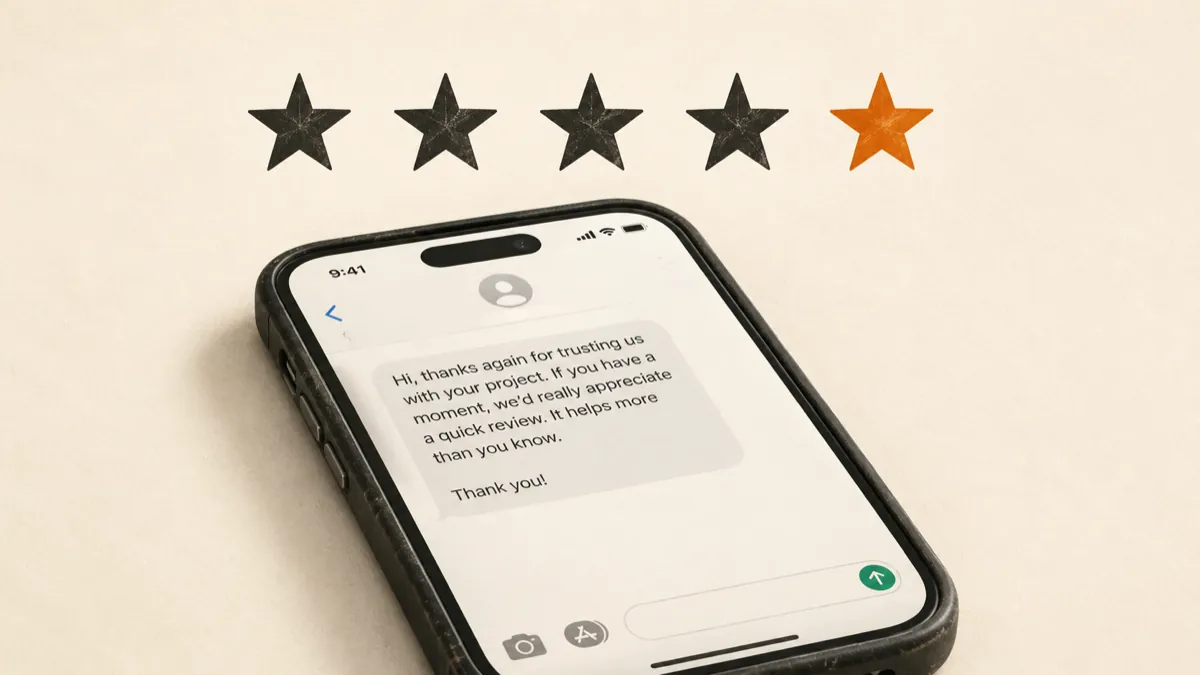
How to Ask for a Review as a Contractor (With Scripts)
Ask for a review in person the moment the customer sees finished work, then text the link within the hour. Name the job, ask plainly, and keep the link one tap away. Per BrightLocal’s 2026 Local Consumer Review Survey, 83% of consumers who were asked to leave a review went on to write one.
Does asking actually work?
Yes, and the gap between asking and not asking is the whole game. BrightLocal’s 2026 Local Consumer Review Survey of 1,002 US consumers found 78% had been asked for a review in the past twelve months, and 83% of those people wrote one. Reviews come from asking, not from good work alone.
Two things about that 83% deserve a caveat, because most articles quote it without one.
First, it is what people say they did, not a measured conversion rate. Second, it counts any review across any business — the person who reviewed their dentist counts. Your real-world rate from a text link will be far lower than 83%. Plan on a fraction of that and you will not be disappointed.
The useful takeaway is not the number. It is that the single biggest determinant of whether a customer reviews you is whether a human being asked them to.
How do you ask for a review as a contractor without sounding needy?
Ask once, in person, at the moment the customer is happiest — standing in front of finished work. Reference the specific job, keep it to two sentences, and hand off to a link they can tap later. Never ask while they are still deciding whether they are satisfied.
The awkwardness people feel comes from asking for a favor with nothing behind it. The fix is sequencing. You have just done a thing the customer can see. Point at it, then ask.
Script: at the truck, in person
“Before I take off — does everything look right to you? … Good. One thing that really helps a small shop like ours is a Google review. I’m going to text you a link right now, and if you’ve got two minutes tonight, I’d appreciate it.”
Then send the text before you pull away. The in-person ask sets it up; the text is what actually gets clicked.
Script: the text, same day
“Hi Karen — Dave from Ridgeline Plumbing. Thanks for having us out today for the water heater. If you’ve got a minute, a quick Google review helps us a lot: [link]”
Short, named, specific, one link. No “we’d love five stars.” No emoji parade.
Script: the one follow-up, 3 days later
“Hi Karen — following up once on this and then I’ll leave you alone. If the water heater’s running right, a short Google review would mean a lot: [link] — Dave”
“And then I’ll leave you alone” does more work than any other line in review requests. It removes the fear of a nagging campaign.
Script: project work, at final walkthrough
“We’re wrapping up. Once you’ve lived with it for a few days and you’re happy, would you mind leaving us a Google review? I’ll email the link tomorrow so it’s sitting in your inbox when you’re ready.”
Remodels, roofs, and additions are different from a service call. The customer’s opinion is not final on day one, and asking too early gets you a lukewarm review at best.
Script: after a callback or warranty fix
“Sorry you had to call us back. It’s fixed, and it’s covered — no charge. If the way we handled it was fair to you, a review saying so would honestly help more than the original job would have.”
This is the highest-value ask in the trades and almost nobody makes it. A review that describes a problem handled well is more persuasive than a review that describes a problem that never happened.
Script: recurring or maintenance customer
“You’ve been with us three years now. We’ve never asked — would you leave us a Google review? Anything you write is fine.”
“Anything you write is fine” is not just politeness. It is the compliant phrasing, for reasons below.
What are you not allowed to say when you ask?
Google’s Maps content policy bans four things contractors do constantly: offering anything of value for a review, asking only your happy customers, pressuring people to review while they are still on site, and requesting that a review include specific content — including content that names a staff member.
That last one surprises people. Here is the exact language from Google’s prohibited and restricted content policy: merchants should not “require or pressure users to leave ratings or write reviews while on the premises, nor should they request that specific content be included,” and the policy explicitly lists “merchants requesting that staff solicit reviews that include specific content, including content that identifies a staff member.”
So the very common script — “if you could mention my name in the review, that helps my numbers” — is against policy. So is “we need ten reviews this month, guys,” which Google names separately as merchants “requesting that staff solicit a certain number of reviews.”
| What you want to do | Allowed? | Source |
|---|---|---|
| Ask every customer for a review | Yes | Google allows soliciting genuine experiences |
| Text a direct review link after the job | Yes | Google publishes the link/QR tool for this |
| Print the QR code and display it in your shop | Yes | Named as a suggested use by Google |
| Offer $10 off, a gift card, or a raffle entry | No | Incentives banned; profile restrictions possible |
| Ask only customers you think are happy | No | Google bans selectively soliciting positive reviews |
| Ask the customer to name the tech | No | Requesting specific content is prohibited |
| Set a per-tech review quota | No | Named example of prohibited solicitation |
| Stand there while they write it | No | Pressuring on premises is prohibited |
On the federal side, FTC rule 16 CFR Part 465 is narrower than most blogs claim. Section 465.4 prohibits compensation “conditioned expressly or by implication” on a review with a particular sentiment. FTC staff give a concrete example of an implied condition: “Tell us how much you loved your visit … and get a $5 coupon.” Asking only your happy customers is not banned by the rule itself — FTC staff say the rule “does not contain a specific prohibition against such conduct,” while warning it could still violate the FTC Act. Google bans it outright, which is the constraint that will actually bite you. More on that in what review gating is.
Should the technician ask, or the office?
Both, in that order. The technician makes the ask face to face because they are the person the customer just trusted in their home. The office sends the link and handles the single follow-up, because technicians on a route will not do it consistently and shouldn’t have to.
Splitting it this way also solves the quota problem. If the office sends the request for every completed job, no technician is being told to hit a number, and no customer gets skipped because a tech guessed they’d be unhappy.
How many times should you follow up?
Twice total: the in-person ask plus one text within a couple of hours, then one follow-up two to three days later. Stop there. A third message costs you more goodwill than the review is worth, and repeated requests to the same customer look like manipulation to both Google and the homeowner.
Which script goes with which job:
| Job type | Ask in person | Send link | Follow up once |
|---|---|---|---|
| Emergency service call | At the truck | Same day, within 2 hours | Day 3 |
| Standard service or repair | At the truck | Same day | Day 3 |
| Install (HVAC, water heater) | After the walkthrough | Next morning | Day 4 |
| Multi-week project | At final walkthrough | 2–3 days after completion | Day 7 |
| Recurring maintenance | At any visit | Same day | Skip |
For more on channel choice, see text versus email review requests and the best time to ask by trade.
What this looks like over a month
Say a plumbing company in Tampa completes 120 jobs a month and currently has no review process — this is a hypothetical, not a customer. They ask on maybe 15 jobs, whenever a tech remembers, and pick up two or three reviews.
They switch to asking on every job: tech asks at the truck, office texts the link, one follow-up on day three. Assume a conservative 12% of requests turn into a posted review — well under BrightLocal’s self-reported 83%, because a real text link is not a survey question.
120 jobs × 12% = roughly 14 reviews a month. That is 168 a year from work they were already doing. The cost is a two-sentence habit and someone owning the send.
The failure mode is not the script. It is month three, when the novelty wears off and the sends stop. Whoever owns the send has to be someone whose job it is, not someone who will get to it.
You can grab your own link with Google’s review link and QR code tool, or use our free Google review link generator if you’d rather not dig through the dashboard.
FAQ
Is it rude to ask a customer for a review? No. Asking is expected. BrightLocal’s 2026 Local Consumer Review Survey found 78% of consumers were asked for a review in the past twelve months, and 83% of those asked wrote one. What reads as rude is pressure: asking twice in a day, hovering while they type, or asking before the work is finished.
Can I ask a customer to mention my technician by name? No. Google’s Maps content policy says merchants should not request that specific content be included in a review, and names staff-identifying content as an example. Ask for a review; let the customer decide what goes in it. Many technicians get named anyway, because customers naturally write about the person who showed up.
Can I offer a discount or a gift card for a review? No. Google prohibits offering payment, discounts, or free goods and services in exchange for any review. Separately, FTC rule 16 CFR 465.4 makes it unlawful to condition compensation on a review expressing a particular sentiment. A discount for any review still risks a Google profile restriction.
How long after the job should I ask? Ask in person as the work is being walked through, then send the link within an hour or two while the job is fresh. Timing varies by trade and job length. Emergency calls close same-day; a multi-week remodel is better asked at final walkthrough, not at first payment.
This is general information, not legal advice.
About Kingpost — Kingpost is a $399/month done-for-you reputation service for residential trade contractors — a real person requests a review from every customer, answers every review within one business day, texts back every missed call, and backs it all with a 30-day money-back guarantee. Get a free profile audit.
Rather have all of this handled than managed? Kingpost does it for $399 a month — start with a free look at your profile.
Get your free audit